

A Writing Update
An Introduction to my Work with Southern Urbanism

Dear readers,
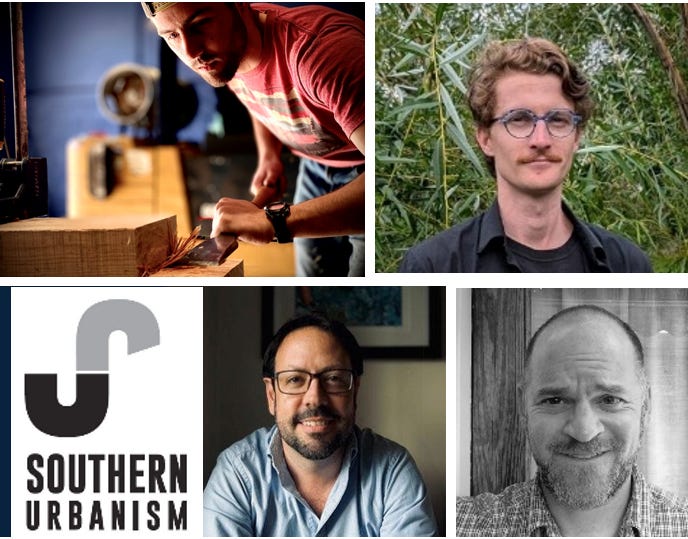
It’s been a minute! I just noticed today that the last essay published on my Substack was in January—wow. I’ve been working on a few pieces simultaneously, and I’m happy to say for the next six months my writing will be published at Southern Urbanism. The editor there, Aaron Lubeck, has brought together a cohort of amazing writers I have the privilege to write alongside. I’ll be sharing previews of those essays with some short opening commentary that will link to Southern Urbanism. Once archived, those essays will appear in full on my Substack. In the meantime, you might get an original essay here as well.
The first essay I’m sharing, “Where Did the Planners Go?”, is a crystallization of thoughts I’ve had for some time now. I argue that the profession is at a crossroads, stuck between the overreach of the modernist era of the past and the impotence of what we might call the “facilitation era” currently. It was inspired by a fellow Substacker, Paul Jones III. It’s always cool when I can draw inspiration from other writers in this community. I ultimately argue that the way through this crossroads is to refine how we do community engagement: to be more plugged in, for one, but to also do a better job of showing, not just telling, through pilot projects.
I’d love to hear from you. What’s your take on the state of the planning profession? How do you envision it improving? And is doubling down on engagement the best way through, especially in a time where the critique of NIMBYs and local veto power is the most prominent it’s ever been? Feel free to comment on the full article or send me a DM.
As always, thanks for your support.
Sincerely,
Billy
Intro
I read an article by Paul Jones III recently that got me gnawing at a particular issue. It’s an article that touches on many things: the decline of the planning profession’s efficacy and influence, an argument for the importance of intentional city planning, and a call for the planning profession to step up. It begins with a powerful question: where are the planners?
This question points to a feeling that planners are missing not just physically in “neighborhood efforts, discussions, block clubs and other grassroots initiatives,” but politically in their influence on the development of cities. On the one hand, planners are absent from opportunities to learn from communities, to build relationships, and to educate the public on important planning efforts. On the other hand, the policies and programs they do advance come not from deep knowledge of communities but from behind a desk.
Jacobsian Turn
These two observations identify both the challenge and the solution to the planning profession’s dilemma. Planners have retreated from the forefront of politics and public discourse. To make the profession more visible and influential, planners need to build credibility through community engagement and political advocacy.
…
Yes, but community engagement must extend to co- design and community empowerment.