

Lewis Mumford’s Clash with Jane Jacobs
Why They Disagreed and What Their Argument Left Unresolved

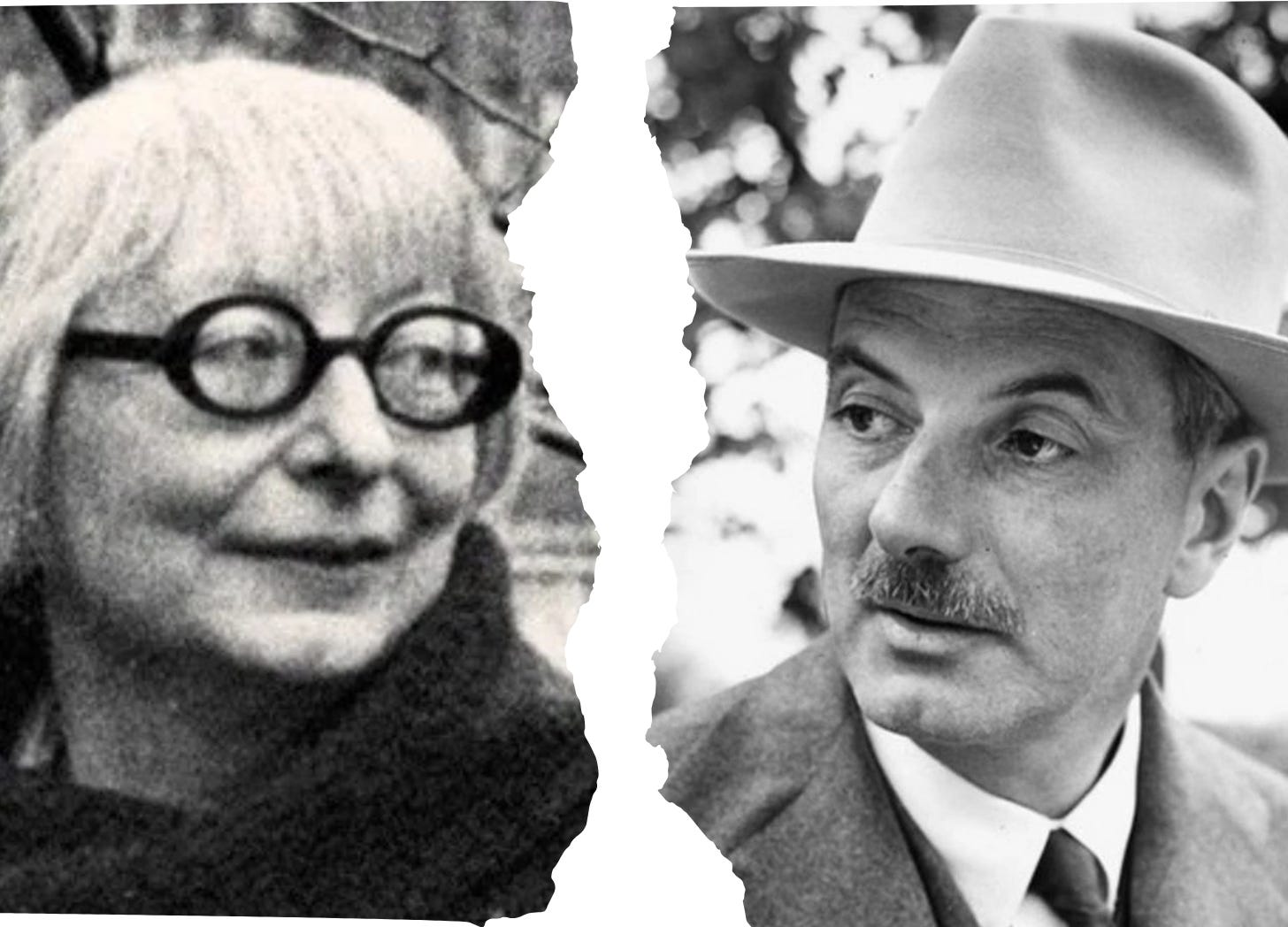
Lewis Mumford is perhaps one of the most astute critics of auto-oriented infrastructure. Even today, his comments from the 1950s ring true. Mumford understood the car’s insatiable appetite for space: how no amount of traffic lanes will ever be enough to satisfy it. You can widen the road, even condemn and demolish homes in the process, but eventually the car wants more. He saw the car as a beast that was never full. The car, in its ruthless pursuit of space, would not only inhibit other modes of transportation but destroy the city itself:
The right to have access to every building in the city by private motorcar, in an age when everyone possesses such a vehicle, is actually the right to destroy the city1
It would come as no surprise that Mumford was opposed to Robert Moses, the controversial figure who hacked his way through tens of thousands of homes to build the Cross-Bronx and Brooklyn-Queens Expressways. If Moses had his way he would have bulldozed thousands more. Mumford stood against everything Moses stood for: he was not only against the belief that neighborhoods should be sacrificed for highways but against a society that pursued capital accumulation and technological efficiency at the expense of community.
While Moses did have his way on many projects, some of which were positive contributions to the city—he built 658 parks and playgrounds—he was thwarted on two big occasions, both of which had urban planning’s most prominent figure at the fore.2 For Jane Jacobs’ first and far more personal fight to save Washington Square Park, Mumford was by her side. So why, then, would Mumford go on to write the most famous critique of Jacobs’ first book, the one that would elevate her to planning stardom, The Death and Life of Great American Cities?
Mumford’s Case
In his essay bitingly titled, “Mother Jacobs’s Home Remedies,” Mumford lays out several interesting critiques. His first is both a compliment and a critique: he says that Jacobs’ book is full of “sense and sentimentality.” Her sense shines when explaining the organized complexity of large cities. But her sentimentality leads her to attribute urban vitality to factors that, Mumford argues, do not account for economic or social vitality. Mumford’s big point is that her prescription for mixed-use and small blocks have no track record of reliably producing the outcomes Jacobs celebrated. He explains:
But if this remedy were a sound one, eighteenth-century London, which met all of Mrs. Jacobs’ planning prescriptions, would not have been the nest of violence and delinquency it actually was.
To say that good urban design is all a neighborhood needs to thrive, discounting economic, environmental, and social conditions, is akin to pruning a tree that is rotting at the root. It might make the tree look good, but it can’t address a deeper, systemic problem. The problem Mumford was concerned with was the ills of modern life, namely the alienation and dehumanization that comes from blindly pursuing technological advancement. Mumford’s critique, in short, was that capitalism and inequity are not neutralized by urban form.
To understand his critique, you have to understand his intellectual influence, his views of the mid-twentieth century, and where he saw it going. As an intellectual descendent of Ebenezer Howard, Mumford celebrated Garden Cities, such as Radburn, New Jersey and Letchworth, UK. These were greenfield developments thoughtfully planned to balance ecology, industry, and community. They typified both the physical and political characteristics of his ideal city, one made up of master-planned communities that balanced density with green space and directed economic development intentionally.
Mumford saw the development of cities, from core urban neighborhoods to new suburban growth, as infected by myopic capitalism, bent on sacrificing all social and moral norms for capital accumulation. He describes NYC’s gridiron, for example, as a “mechanical pattern” that prioritized the financialization of land over thoughtful urban design and human needs. He explains:
Thus the city, from the beginning of the nineteenth century on, was treated not as a public institution, but a private commercial venture to be carved up in any fashion that might increase the turnover and further the rise in land values.3
Yet he wasn’t pleased with the suburbs, either. As a solution to the ills of the modern city, they failed terribly. To Mumford, the shortcomings of the central city and the suburbs were part and parcel of the same issue. Capital exploitation led to crowding and unsanitary living conditions in central cities. In seeking to flee these outcomes, people were only presented with soulless development at the expense of environmental destruction and social isolation:
Those who leave the city wish to escape its snarling violence and its sickening perversions of life, its traffic in narcotics and its gangster-organized lewdness, which break into the lives even of children. Not least, the suburban exiles seek to find some nightly surcease from constant bureaucratic regimentation: Punch the time clock! Watch your step! Curb your dog! Do not spit! No parking! Get in line for a ticket! Move on! Keep off the grass! Follow the green line! Wait for the next train! Buy now, pay later! Don’t buck the system! Take what you get!”4
And in exchange for their hopes of relief from the city, suburbanites get “a low-grade uniform environment from which escape is impossible.”5
The solution to these two equally bad choices—the congested city or the regimented suburbs—was an entirely new approach to building cities, inspired by Ebenezer Howard:
Above all, by his insight into the corporate and unified structure of a city, Howard called attention to the fact that the growth of a city must be in the hands of a representative public authority; and that the best results could be achieved only if this authority had public power to assemble and hold the land, plan the city, time the order of building, and provide the necessary services.6
Mumford wanted far more control in public hands. He wasn’t satisfied with a public authority controlling zoning and roads. Even Savannah, GA, which was deliberately planned with a tight, walkable street network and plenty of parks, was not good enough, for this approach gave up individual lots to private developers. No, Mumford wanted a public entity to plan and develop everything from a single site to a regional transportation network. It would need to be done that way to develop a cohesive whole:
No longer were the most essential agents of city development to be left to the individual investor, whether speculator or owner, dealing with individual building lots, individual houses, individual business sites; for no individual exercise of either foresight or public spirit could produce the equivalent of a co-ordinated and meaningful whole.7
Mumford’s disagreement with Jacobs couldn’t be more clear here. While she celebrated individual exercise as a driver of adaptive, bottom-up complexity, it was for Mumford a non-starter. It’s not that Mumford wanted to rid cities of complexity or diversity. In fact, he praised Jacobs’ articulation and appreciation for the intricately interconnected nature of life in a big city and the value of its “racial, national, and cultural variety.”8 But he refused to conflate those qualities with an excuse for density that he thought exceeded a healthy limit.
Mumford’s language—“sickening perversions of life” and “gangster-organized lewdness”—would color him as a conservative by today’s standards. It’s clear that Jacobs and Mumford did not see the same city. I’m sure there were aspects of city life they could both agree needed improvement, but Mumford tended to see disorder where Jacobs saw cooperation. In an interview, she even recalls wondering if Mumford hated the city:
I had my doubts about him because we rode into the city together in a car. And I watched how he acted as soon as he began to get into the city. And he had been talking and all pleasant, but as soon as he began to get into the city he got grim, withdrawn, and distressed. And it was just so clear that he just hated the city and hated being in it. And I was thinking, you know, this is the most interesting part.
In historical context, the 1950s New York Mumford was critiquing was far less violent than the city from the 1970s to 1990s. It’s more useful to take his critique as a warning. If the city is a physical instantiation of our morals, a poorly designed city would surely produce a degraded society, one bereft of what Robert Sampson calls “collective efficacy,” or a sense of belonging and a willingness to take care of one’s community. If we give the city over to the wants of industry—crowding workers into cramped and unsanitary housing to fuel corporate production, or bulldozing communities for highways to make the car a more useful and profitable product—how can we cultivate communities built on shared meaning and cooperation? A city built around enriching corporate interests at the expense of the community could only have disastrous long-term consequences.
To let our cities continue developing intensely and somewhat experimentally as Jacobs argued would be to let go of a moral discipline that Mumford thought was essential to maintaining social wellbeing. Jacobs’ support for market-driven urbanism was at odds with Mumford’s ideal approach to planning. For Mumford, Greenwich Village’s vitality wasn’t guaranteed by the dense, mixed-use quality that Jacobs’ celebrated, and he’d argue that those factors were also responsible for producing poor outcomes elsewhere.
Mumford particularly took issue with Jacobs’ declaration that a city cannot be a work of art; to him it must be, for a city is a reflection of our social values. If cities aren’t designed around values, who are we leaving it to be designed by? For Mumford, we left it to capitalism: to slumlords that keep residents in cramped and filthy lodgings, to a consumerist culture that focuses our attention and need for belonging on “keeping up with the Joneses,” and to a laissez-faire economy that must externalize the costs of pollution and poverty to make a profit.
To Mumford, Jacobs didn’t have a theory or ideal to work towards. She thought that with the right planning guardrails we could trust the market and local communities to produce good outcomes from the bottom up. Mumford was saying that even though your neighborhood may be lively and animated, it still may exist in a society that is moving toward destructive ends. For Mumford, there was no containing the market within the existing paradigm.
His proposals were radical because he envisioned not only a new way of building cities but a new way of organizing society. We need, he said, a “a many-sided environment capable of sustaining the greatest variety of human interests and human purposes. An environment that has been reduced to the level of the machine, correct, undeviating, repetitious, monotonous, is hostile to organic reality and to human purpose.”9 He was fighting for cities that could only come about by a restructuring of the economy, polity, and society.
Jacobs’ Rebuttal
Despite Mumford putting himself on the other side of history from Robert Moses, Jane Jacobs didn’t exactly see it that way:
What was a really major bad idea about the Garden City was you take a clean slate and you make a new world. That’s basically artificial. There is no new world that you make without the old world. And Mumford fell for that and the whole ‘this is the 20th century’ thing. The notion that you could discard the old world and now make a new one. This is what was so bad about Modernism.10
Mumford assumed that an ethical framework could save us but Jacobs was unconvinced that state power could self-correct state power. She looked at the damage Moses was inflicting on New York City and asked if anyone with that much power could be trusted. Ethical framework or not, Jacobs saw value in diverse local markets that were protected from dramatic top-down interference.
Jacobs was never going to go for a top-down, finished-state proposal for city design. While Mumford wanted to build new cities reflective of morals, Jacobs’ moral code celebrated the messiness she feared Mumford wanted to wipe clean. The value she observed and articulated was not conducive to master planning. To her, no amount of forethought could predict the future needs of a community. To improve the outcomes of mid-century cities, Jacobs proposed relying on observations and incremental improvement, not radical and abrupt change.
She said Garden Cities were defined by a “dominant theme of harmony and order imposed and frozen by authoritarian planning.”11 She claimed that “modern city planning has been burdened from its beginnings with the unsuitable aim of converting cities into disciplined works of art.” The order of art, she argued, is very different from the order of life.
She articulated what would become an infamous characteristic of bureaucratic planning.
One seemingly logical step is taken after another, each step plausible and apparently defensible in itself; and the peculiar result is a form of city which is not easier to use and to get around in, but on the contrary more scattered, more cumbersome, more time wasting, expensive and aggravating.12
The defense of planners and engineers today is that as long as they follow the codes and manuals accordingly they can be absolved of any perverse outcomes. A crosswalk can’t be installed unless we see enough people risking their lives to run across the road—it’s just what the manual says. An abandoned, historic apartment building can’t be rehabbed to create more housing—it must continue to be a blight on the neighborhood because the land use plan deems it incompatible. They do everything by the book without questioning the logic of the book. It works as a defense so long as their job is not to question its compatibility with reality. Jacobs’ biggest challenge to the planners was to start with reality and work up: to be humble in their observations and open to seeing meaning in the mundane and complexity in disorder.
Jacobs was prophetic in her criticism of the planning profession. Her list of what planners were ignoring are all things planners of today would agree with:
Most of the aims I have been writing about, aims such as unslumming slums, catalyzing diversity, nurturing lively streets, are unrecognized today as objectives of city planning.13
Her thinking was decades ahead of her time and, as someone never formally trained in planning, a reflection of the inadequacies of the profession and the drastic need for a holistic reckoning. In criticizing planners of her time, she inadvertently trailblazed the direction the profession would take for the next several decades.
An Unresolved Problem
No matter on whose side you stand in this famed debate, the lessons offered by both are as relevant as ever. We haven’t fully integrated Jacobs’ insights into our land use laws in cities and urban neighborhoods, and our suburbs continue to lack any thoughtful or deliberate long term plans Mumford wanted. Today, we have the worst of both worlds: a top-down planning paradigm that doesn’t allow for incremental change yet is designed for dangerous, unhealthy ends.
Jacobs’ legacy on the planning profession is unalterable, evidenced in her influential vocabulary: eyes on the street, sidewalk ballet, organized complexity, cataclysmic money, and so on. She showed how valuable diversity is: in buildings, in land uses, in people. She argued that the lively commotion some perceived as disorder was the organized complexity of a vibrant community.
Yet, despite a few quotes here and there, Mumford seems comparably less important. In a country where a fraction of so-called “urban” residents live outside of walkable neighborhoods, I think this is an oversight.14 Jacobs, in all her brilliance, was focused on urban neighborhoods. Mumford was concerned with the city of the future, what became the sprawl we’ve built in the decades since he sounded the alarm.
The scope of the suburban landscape of the ‘50s and ‘60s pales in comparison to what exists today. Mumford saw the opening act of what would become a decades-long investment in suburban development, yet in its early days he recognized its potential to take over our country and further replicate its harms.
Take Phoenix, for example. What was a city of around 100,000 in the 1950s is now a metropolis of 5 million, defined largely by sprawl that all but mandates car ownership. Across the Sunbelt, the suburbs have moved beyond mere appendages of dense urban development to becoming the primary form of development. You can drive across this landscape and find yourself in city after city that lacks any discernable downtown. In these places, there is no city to run from and no city to return to.
Mumford’s larger mission of building better societies, if you can excuse his grand modernist approach to scraping everything for something new, is not only respectable but incredibly relevant in a society where funding for public goods is on the decline. I really resonate with one of his foundational principles: “Responsible public direction working for well-conceived public ends is essential for the foundation and development of all urban communities.”15
In today’s planning paradigm, there is no well-conceived public end in sight. Rather than thoughtfully planning future growth, our cities unfold haphazardly without thoughtful, intentional guidance. We no longer plan street networks, but let subdivisions produce isolated designs that waste land and reinforce car dependency. Instead of creating vibrant, well-designed places to make the most of growth, we let the population sprawl across the landscape in undifferentiated urban slop.16 Growth becomes a value loss rather than a value add.
Cities are, undeniably, public goods. They serve us economically, socially, and culturally. They are also an opportunity for government to showcase what kyla scanlon calls visible competence: the infrastructure of a thoughtful and well-designed society. In the spirit of Mumford, she continues:
Infrastructure is emotional architecture. When things work, people believe life can too. Maintenance generates trust. Trust compounds.
Mumford was making this exact argument: that the design of our cities and the strength of our collective efficacy go hand in hand, each one strengthening and building the other.
Decades later, we know how urban design affects the way a neighborhood functions. We have a vision and a vocabulary for visible competence in urban neighborhoods. We have Jacobs to thank for that. But when it comes to growing outward and delivering a suburban design that doesn’t decimate nature and community, we appear lost. We don’t need a revival of Garden Cities. But we do need a revival of bold, visionary thinking about the future of suburban growth.
Enjoy my writing? Consider supporting my work by buying me a coffee.
“Babel in Europe,” The Highway and the City, 1957, p. 11
The first was saving Washington Square Park from the Fifth Avenue Extension and the second was stopping the Lower Manhattan Expressway.
Mumford, The City in History, 1961, p. 426.
Mumford, “Mother Jacobs’ Home Remedies,” 1962
Mumford, The City in History, 1961, p. 486.
Ibid, p. 521
Ibid
Mumford, “Mother Jacobs’ Home Remedies,” 1962
“The Case Against Modern Architecture,” The Highway and the City, 1962, p. 173
“An interview with Jane Jacobs, Godmother of the American City,” Metropolis (May 4, 2016). Except that making a new world is what suburbia did: it remade the countryside with a development pattern that was unprecedented. It wasn’t cities we wiped clean, though some neighborhoods definitely were, it was the countryside that we paved over with undifferentiated urban slop.
Jacobs, The Death and Life of Great American Cities, p. 374
Ibid, p. 355
Ibid, p. 321
Census data shows that around 80% of US residents live in “urban” areas, but a large share of these areas remain unwalkable. You can explore the EPA’s walkability index map here. What it needs is an urban area overlay—I may make a few maps in the future.
Mumford, The City in History, 1961, p. 444.
Much like slop bowls that provide the basic nutrients one needs without any concern for the joy that accompanies the challenge of cooking, the visual pleasure of thoughtfully arranging ingredients, and the reward of tasting a dish prepared to perfection, the style of development happening at the edge of cities is programmatically functional but physically ugly and spiritually devastating. The slop we call urban development has the added bonus of contributing to 40,000 yearly deaths on streets designed for cars.
This is one of the best pieces I've read in a while. Jane Jacobs will always be a legend in my eye. Some of the modern criticisms of her leadership are revisionist criticisms. To tackle what she tackled when she tackled them against the forces at play was a stroke of brilliance. Was it the ultimate panacea of all of the problems? Absolutely not. The important part here is this: quality of life is an intensely multifaceted problem. Even with brilliant urban design, citizens can struggle. Even with a vibrant community, there is no guarantee that the vibrancy will touch every citizen--which is the ultimate aim. More to the point, the ideas of Jacobs were ideas of the time, the moment, and the ecosystem. A lot of Jacobs (and Mumford's) ideas still resonate today, but our modern society is quintessentially different than the days of Jacob's and Mumford's. Here's the point: we're not close to figuring this all out, but man we have to keep trying.