

Reflections on Amsterdam

A humane city
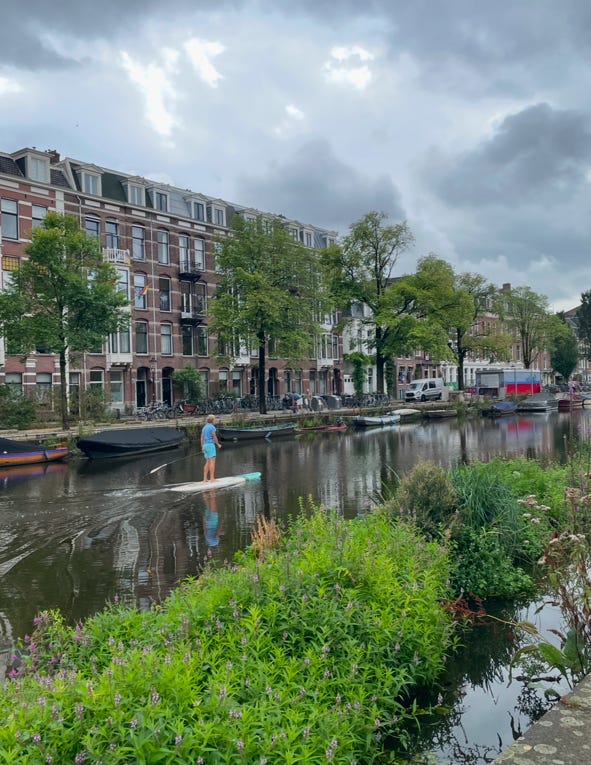
I did it. I finally made it to Amsterdam. As someone obsessed with urban design, this has been a dream of mine for quite some time. The city’s many canals, narrow streets, skinny historic buildings, and miles upon miles of bike lanes make it a place not only full of charm but one that follows the basic principles of good urbanism. The entire city feels humane, from the dense neighborhoods in the city center to the quaint villages at the edge of town. Nearly every street feels like a place built for humans. That may sound like an obvious statement. Aren’t all cities built for humans? Not quite.
As a U.S. resident, I constantly find myself in spaces that feel inhumane. Spaces that were not designed for human beings living on their own two feet. The scale of buildings, signs, and streets in many US locations are designed to accommodate the automobile: big, bulky machines that move at agile speeds unimaginable before the industrial revolution. This leaves us with spaces that are larger than the human scale and feel uncomfortable on foot.
Attempting to walk along a highway or cross a seven lane road feels uncomfortable because the space given to pedestrians or cyclists are afterthoughts. These spaces feel inhumane because they are hostile and undignified for anyone outside of a car. From the loud noises to the deathly speed of cars whizzing by to the narrow confines you are afforded, they make you feel like a fool for not driving, for not enclosing yourself in an air-conditioned fortress to whiz through space. What we’re left with when we design our cities for cars are spaces to move through, not places to be in.
On the contrary, I felt like I belonged on every street in Amsterdam. Every street felt like a place I was not only welcome in but one I wanted to be in. The buildings were built at a scale for me. They were easy to access. The space dedicated to pedestrians and cyclists were as wide or wider than the space dedicated to cars. There were other people walking and biking by. I felt safe.
A quiet city
Despite being really dense, Amsterdam is very quiet. The largest sounds in the center city are people because of how many tourists there are. Unlike the US, cars are a very small portion of noise and there is an incredible absence of honking. I heard one car honk during my entire week there. Even at intersections with lots of conflict, pedestrians, cyclists, and drivers all coordinate their movements in silence (aside from the occasional bicycle bell, which sounds quite pleasant). It’s amazing to see so many transportation modes mingling seamlessly at intersections with no signs or signals.
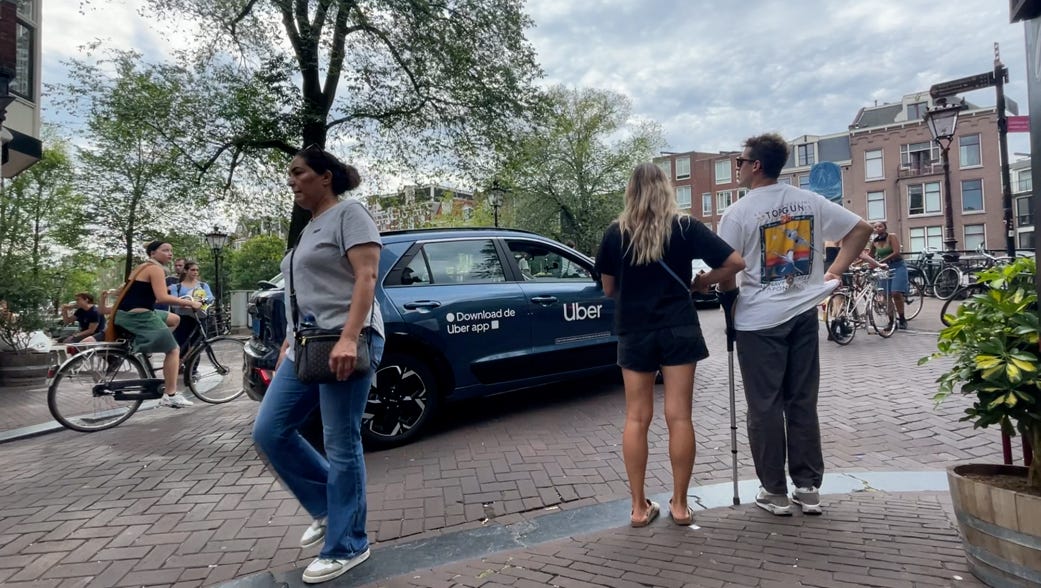
The American critique of Europe packing people in like sardines falls flat. Sure, in the most tourist parts of Amsterdam you can feel overwhelmed by the amount of people vying for space. But most neighborhoods are remarkably calm and quiet. Once you experience this you realize that most unwanted noise in the US comes from traffic. Whether it is the whizzing of cars on the highway or honking horns, cars curse cities with noise that in some places can rise to a level that is considered pollution. The conception that cities are loud has nothing to do with lots of people living in close quarters but everything to do with loud machines.
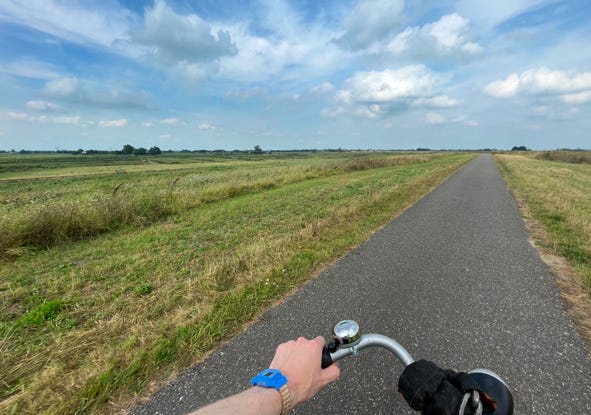
I was also blown away by the cycling infrastructure. Rather than being an exception, protected bicycle lanes are standard practice. The only streets that don’t have protected bike lanes are narrow, one way neighborhood streets with low traffic moving at low speeds. Even in the countryside there is a network of bike lanes cutting through farms and old villages. While in Amsterdam, I took a long bike ride to a nearby island outside the city. There were so many bike lanes in the countryside that I could have taken a wrong turn at dozens of intersections with bike lanes going in all directions. And I was far from the only person out there. Many other people of all ages were enjoying a nice ride past farms, cows, and even a cute dairy farm selling ice cream.
In Amsterdam, it's rare to find a road with more than one directional travel lane for a car. Traffic is managed not by affording more space to cars but through demand mitigation which encourages other modes of mobility, street density that disperses all modes of travel across many streets, and land use mix which puts housing and destinations closer together.
Demand mitigation is immediately apparent once you consider just how many bicycles are parked on a given street compared to cars. While the space dedicated to parking for both bikes and cars might be similar on a given street, a dozen or so bikes can fit into one car parking space. Wherever you go in Amsterdam, there are parked bikes. And this speaks to the accessibility of their bicycle network. In the US, bicycle accessibility is few and far between. Cyclists map out their routes beforehand for safety, figuring out ways to traverse street networks that are hostile to their choice of transportation (maybe if I go two more blocks over than I need to, I can avoid that dangerous intersection). Cycling in Amsterdam, on the other hand, feels like the city has rolled out the red carpet for you. Bicycle lanes and safe streets are a given, as is the social and physical accommodation of bikes on public transit. This is accomplished without a zero sum game environment which disadvantages cars. In fact, it's the extensive space given to bikes that makes less space for cars okay.
The illusion of freedom
The opposition to removing space from cars is often perceived as a threat to individual freedom. Americans often associate cars with freedom. Given the way we’ve built our cities, this is largely true. But my time in Amsterdam shows me it’s not a universal truth. Most days I was catching a train, a ferry, or a street car (sometimes all three) to get around the city. There is a freedom to being able to walk to a train or ferry station without worrying about when it will come next because the wait will never be longer than 10 minutes. There is a freedom to being able to let my mind wander, to tinker on my phone, or read a book while I travel. There is a freedom to stress-free traveling. There’s no traffic congestion when you’re on a train, no one honking at you because you saw the green light a few seconds too late, and no parking space to search for. There’s no pressure.
For people who say public transit sucks. There are trade offs either way. You wait for the bus or you wait in traffic. There is a delay in service or there is a detour. The bench at the bus stop is full or you can’t find a parking space. You don’t have to worry about parking or you get to leave whenever you want. You get to read a book while you travel or you get to choose a scenic alternative.
It's okay for people to want a big house with a large yard. Amsterdam has those too. But in too many cities, we attempt to accommodate those desires where economic activity demands intensity and density. So communities compromise by widening roads and building lots of surface parking to draw temporal intensity and density by injecting people by car from surrounding areas.
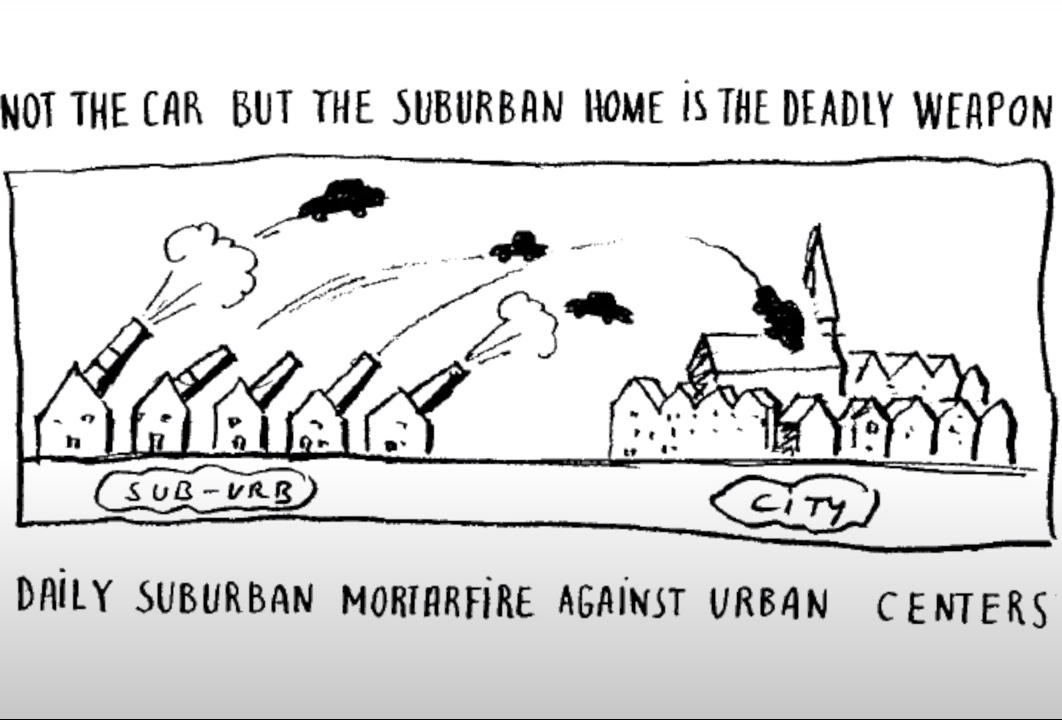
U.S. residents want freedom-by-car and urbanism at the same time. They want to drive everywhere and have all the urban amenities at their fingertips. They want to have their cake and eat it, too. Unfortunately, an addiction to cars will never come without adverse consequences. Cars bloat cities with wide roads and parking lots, making any non-car trip inefficient. They kill and harm people both inside and outside them. And when they’re not harming people directly, they lower public health outcomes. A good, healthy urbanism will never arise in the U.S. while we are dependent on a car addiction. We will never get far unwilling to sacrifice on-street parking for bike lanes, or travel lanes for bus lanes, or parking lots for new housing.
Conclusion
We can make arguments about preferences all day. Some will argue Americans prefer the suburbs. Others will argue the market isn’t free enough to make that assumption. But at the end of the day, this isn’t simply a matter of preference. It’s a matter of building communities that are healthy and safe. U.S. urbanism is objectively unhealthy and dangerous; this is not up for debate.
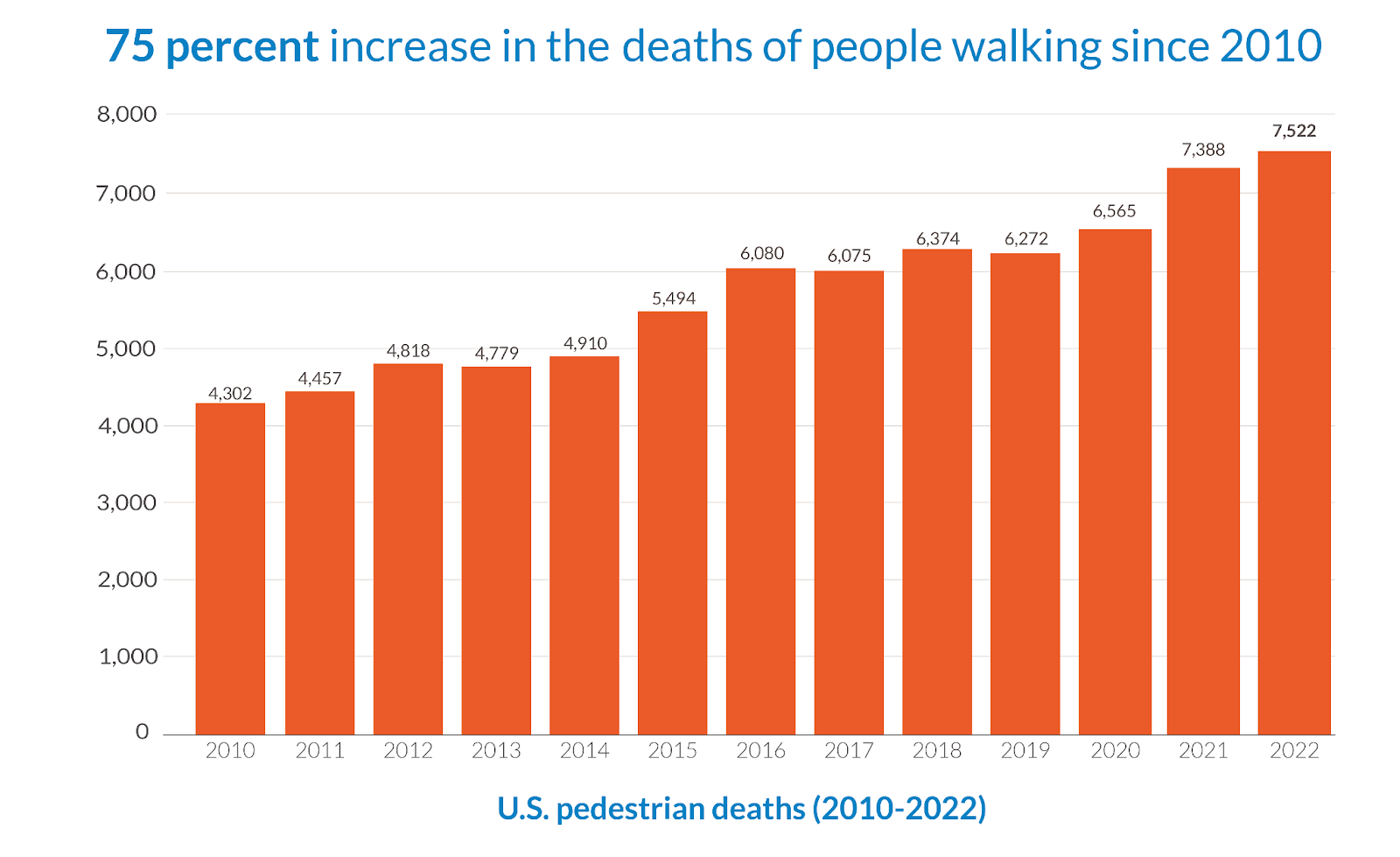
Recent research shows that “using a car for over 50% of out-of-home activities lowers life satisfaction.” Of course it does. People who are more sedentary are bound to be more unhealthy. And even for the people in car-oriented communities who don’t succumb to sedentary lifestyles—the kind that our environment makes it easy to do—are still at risk of being injured by cars. Over 40,000 people die every year in accidents and 7,522 of them were pedestrians in 2024. And pedestrian fatalities have been increasing in recent years.
I like to think that, in the future, we will view car dependence in the same way we view smoking today. It would be a social affront to light up in a restaurant and completely idiotic to claim that smoking is beneficial. Cars and all their negative consequences deserve the same fate.
That last thing I want to do in this essay is praise the Texas Department of Transportation. But I was surprised to find out recently (just now) that they were responsible for the famed “Don’t Mess with Texas” campaign against littering. They coined a phrase so catchy that it is still used today. But it wasn’t just catchy. It reduced litter along state roadways by 76% from 1987 to 1990.
Urban planning needs a “Don’t Mess with Texas” moment. Not local protests here and there, but a campaign on a national level. Our addiction to cars—and the lies we tell ourselves to perpetuate it—has to end. This won’t be easy. But if the country can commit to it, the benefits are immense. Amsterdam proves that.